 Print
Print
 Add to Favorite
 Share
ShareH.E. Eng. Ahmed bin Suleiman Al-Rajhi, Chairman of the Board of the King Salman International Award for Disability Research, announced the winners of the fourth edition of the Award, which attracted broad international participation, with 770 nominations received from 111 countries across all six continents, representing more than half of the world’s countries.
His Excellency emphasized that the fourth edition represents a significant milestone in the Award’s development and reflects its growing international presence and scientific standing, with the continued support and close follow-up of HRH Prince Sultan bin Salman bin Abdulaziz, Special Advisor to the Custodian of the Two Holy Mosques and Chairman of the Board of Trustees of the King Salman Center for Disability Research.
Al-Rajhi explained that the broad participation in this edition reflects the growing international interest in disability research and the Award’s role in recognizing impactful scientific and research achievements, promoting innovation, and facilitating the exchange of knowledge and expertise at the international level.
Five Main Award Categories
The fourth edition featured five main award categories:
Health and Medical Sciences
Psychological and Educational Sciences
Rehabilitation and Social Sciences
Technological Applications in Disability
Universal Accessibility
The Award’s scope was expanded over the last two editions to include Technological Applications in Disability and Universal Accessibility, in response to developments in disability research and practice and in line with the objectives of Saudi Vision 2030.
Strong Governance Across the Evaluation and Judging Process
Throughout the fourth edition, the Award Board, General Secretariat, and relevant committees worked in accordance with clear governance procedures covering nomination, evaluation, judging, and approval of the results.
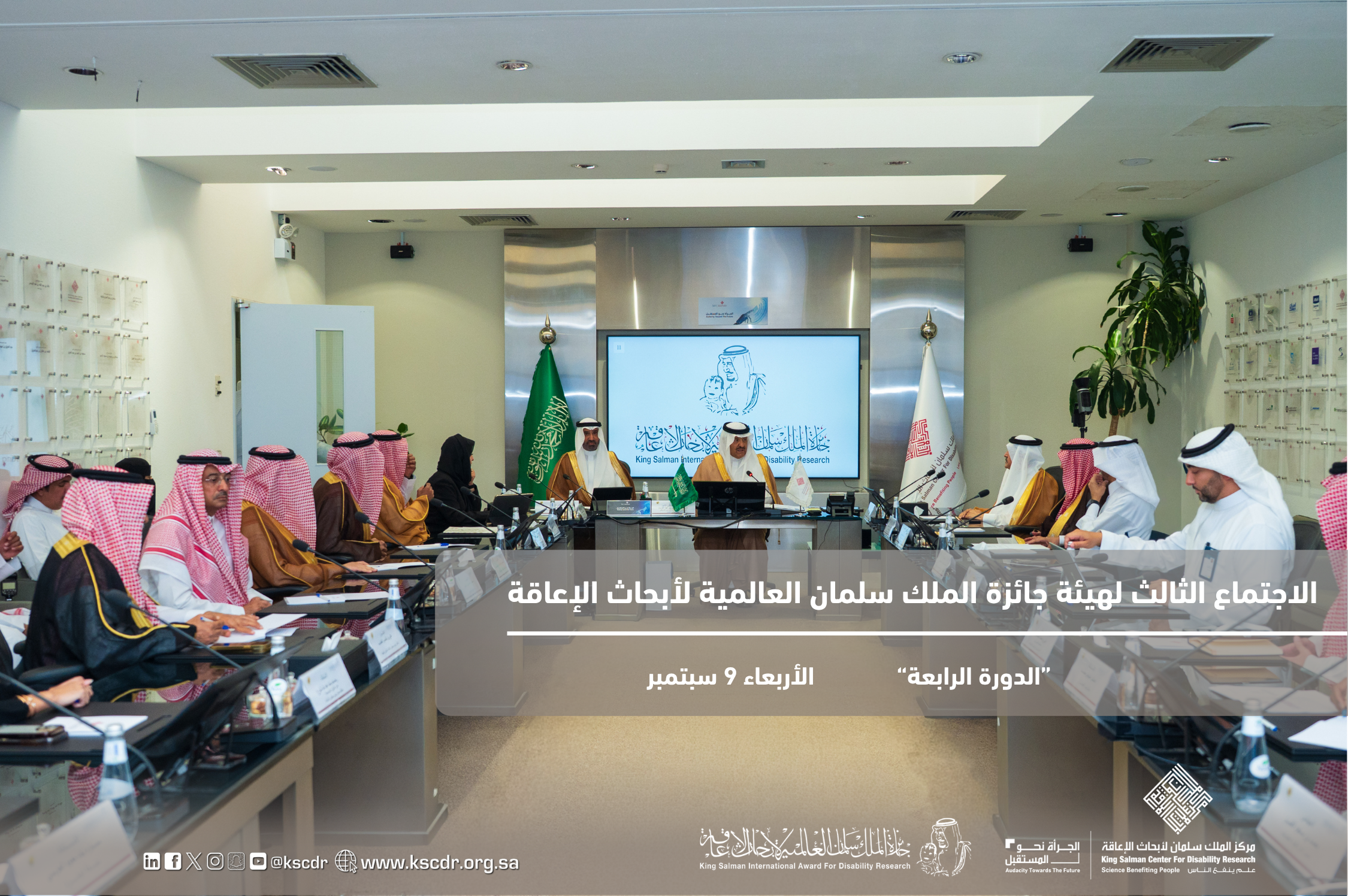
During the edition, three meetings of the Award Board, one meeting of the Joint Team, and ten meetings of the Scientific Committee were held, in addition to meetings of the relevant subcommittees.
A series of workshops was also held to explore ways to strengthen the Award’s international presence and support its long-term scientific standing and development, in coordination with the Executive Management of the King Salman Center for Disability Research.
Six Months of Evaluation and Judging
The evaluation and judging process spanned six months and was conducted in several stages. The process began with a review of the nominations to verify their compliance with the Award’s eligibility requirements, followed by the selection of the top ten nominees in each category for the shortlist.
This was followed by the selection of three nominees in each category for the final stage. In the final phase, the recommendations of the judging committees and the results of the comparative assessment were reviewed in accordance with the Award’s approved criteria.
The Award Board subsequently approved the winners, with two winners selected in four of the five categories.
Winners of the Fourth Edition
Based on the decision of the Award Board, the winners of the fourth edition are as follows:
First: Rehabilitation and Social Sciences
Christopher Gerard Maher — Australia
Stefano Negrini — Italy
Second: Technological Applications in Disability
Conor Walsh — Ireland
Rory Alan Cooper — United States of America
Third: Health and Medical Sciences
Steven Wayne Scherer — Canada
Valery Lvovitch Feigin — New Zealand
Fourth: Psychological and Educational Sciences
Daniel Patrick Hallahan — United States of America
Fifth: Universal Accessibility
Abdul Latif Al-Fawzan Autism Center — Al Khobar
ACCEL INTERNATIONAL Ajyal Center — Dhahran
Eng. Ahmed Al-Rajhi affirmed that the selection of the winners followed a rigorous scientific evaluation of their contributions, achievements, and impact within their respective fields of specialization, in accordance with the Award’s approved criteria and the reports of the judging committees.
Al-Rajhi congratulated the winners of the fourth edition and expressed his appreciation to the members of the Award Board, the Scientific Committee, judges and experts, the General Secretariat, the executive team, and everyone who contributed to the successful implementation of this edition.
Continued Support for the Award
Al-Rajhi expressed his appreciation to the Custodian of the Two Holy Mosques, King Salman bin Abdulaziz Al Saud, and HRH Prince Mohammed bin Salman bin Abdulaziz Al Saud, Crown Prince and Prime Minister, for their continued support of disability and scientific research, and for their support of the King Salman International Award for Disability Research.
He also expressed his appreciation to HRH Prince Sultan bin Salman bin Abdulaziz, Special Advisor to the Custodian of the Two Holy Mosques, for his continued follow-up and support of the Award and his commitment to its development and international presence.
Al-Rajhi further thanked the management of the King Salman Center for Disability Research and all those who contributed to the successful implementation of the fourth edition.